
Newly review · Hands-on test · October 25, 2026
Newly Review: We Built and Exported a Native Mobile App
Newly is an AI-native mobile app builder that generates React Native / Expo apps for iOS and Android from natural-language prompts. We used it to build StackCheck, a subscription and software-buying tracker, then pushed it through billing changes, reminders, authentication, cloud data, source export and an Android build.
Disclosure: Newly provided Toolessence with complimentary access (a $25 plan with 100 credits, ending October 30, 2026). This review is not sponsored. Newly had no review, editing or approval rights, and the complimentary access did not determine the verdict. Pricing update, October 28, 2026: Newly's main pricing page and FAQ advertise $25/month with 100 credits/month, also confirmed by the partner in writing. This is no longer merely an unknown test-account allowance. Some secondary official pages still show 50 credits for $25/month, and the credit-usage documentation remains inconsistent — check the applicable terms before buying.
Verdict
Newly was more capable as a development agent than its testing infrastructure was reliable. It generated a real native app, handled iterative changes, built a backend with authentication and per-user isolation, debugged its own backend bug, and produced a meaningful source export and a downloadable APK. The embedded iOS simulator, however, repeatedly failed to launch within its time limit, small UX bugs crept in during iteration, and the export still depends on some Newly-hosted services. We did not assign a numerical score.
At a glance
- What it is
- AI-native mobile app builder generating React Native / Expo apps for iOS and Android from prompts.
- Test date
- October 25, 2026
- Test project
- StackCheck — a native app for tracking software subscriptions and buying decisions.
- Model used
- Default Newly Agent, unless stated otherwise.
- Tested on
- Newly's embedded iOS simulator. Android was built but not run on a device or emulator.
- Exports
- Full source ZIP downloaded and inspected; standalone Android APK generated and downloaded.
- Overall conclusion
- More capable as a development agent than its testing infrastructure was reliable.
First generation: a working native app
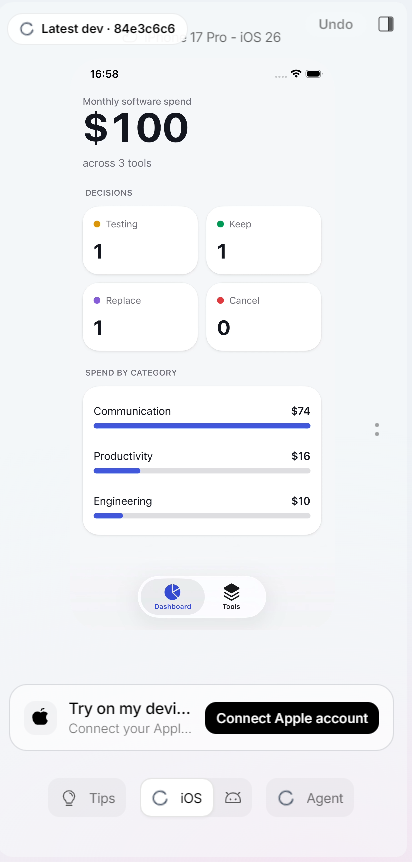
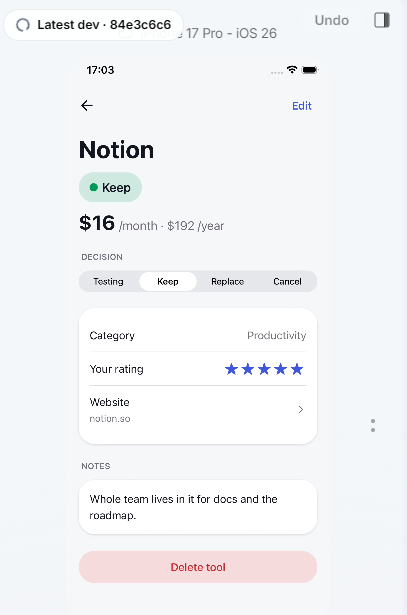
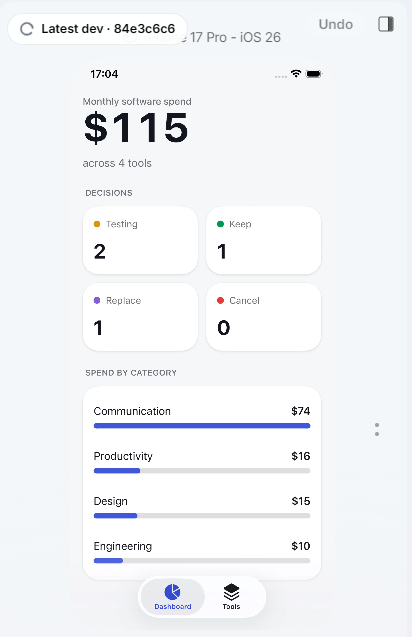
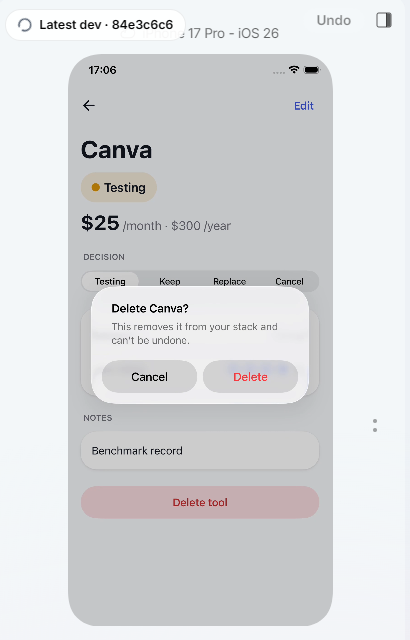
Our first prompt asked for a dashboard, saved software tools with full create/edit/delete, search and filtering, monthly spend calculations, local persistence, and iOS and Android support. Newly generated a working React Native / Expo app. On the iOS simulator we verified the dashboard, the initial $100 monthly spend across three sample tools, the tool detail view, adding and editing a tool, dashboard recalculation, and deletion with a confirmation step.
Newly also added things we did not ask for, such as a yearly-cost presentation, haptics and extra visual behavior. Instruction adherence was good, but not perfect.
Iteration test: monthly vs annual billing
We asked Newly to add a Monthly / Annual billing frequency without redesigning the app. For an annual $120 tool, StackCheck correctly normalized the cost to $10/month. The dashboard, tool cards and detail view updated, and existing records and features were preserved. This change consumed roughly 3 credits in our account. Newly is investigating this observation; we do not label it a confirmed bug.
Native feature test: renewal reminders
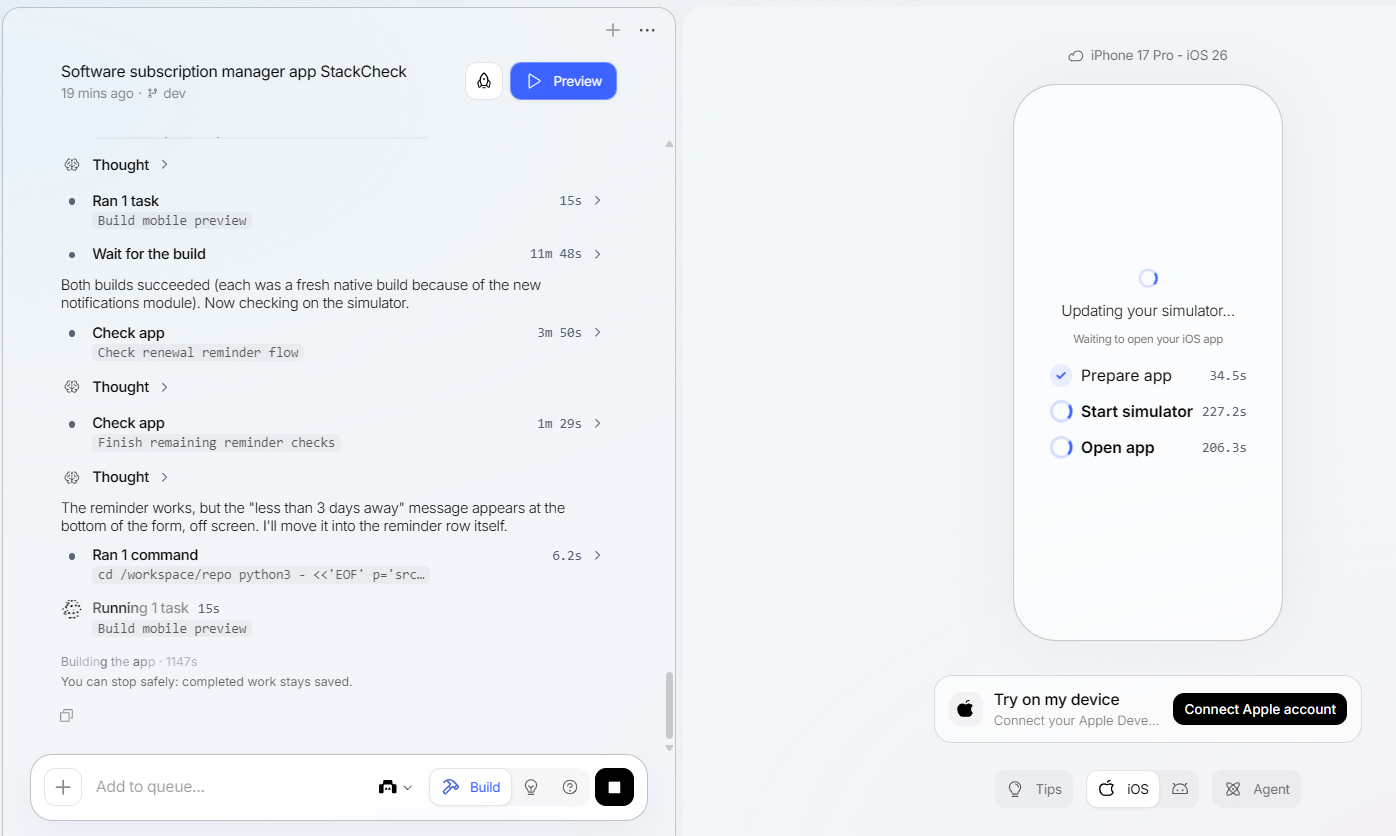
Next we asked for an optional renewal/trial date and a local notification three days before it. Because this required a notifications module, Newly ran fresh native builds — and both the iOS and Android builds succeeded.
On the iOS simulator we verified the date workflow, the reminder toggle, permission behavior during the test, the reminder dates displayed in the app, and the reminder state in the interface. We did not independently verify that the operating system ultimately fired the scheduled notification.
UX issues we observed
- The date picker could let taps pass through to controls behind it.
- Some reminder helper text did not always restore correctly after changing dates.
Authentication and cloud backend
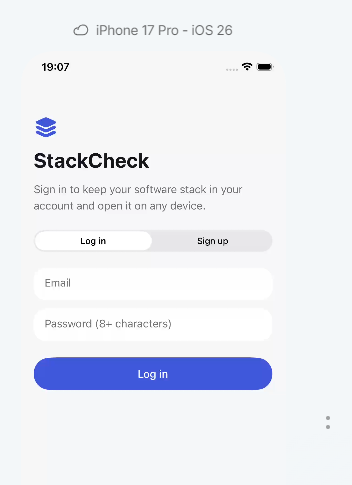
We then asked for authentication and cloud persistence. Newly created and deployed a backend, and during implementation the agent found and fixed a real bug in the import route's authentication middleware.
We verified:
- sign-up, logout and login, and session persistence across an app restart
- cloud records persisting after login, and local-to-cloud import
- create, edit and delete on cloud records, with correct dashboard calculations
- a second account initially seeing none of the first account's data
- API-level user-isolation tests with two accounts, and unauthenticated requests being rejected
Simulator reliability: useful, but not consistently reliable
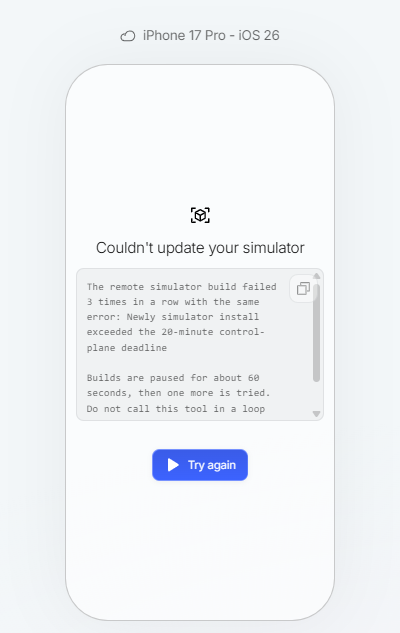
Newly's embedded iOS simulator genuinely worked — we used StackCheck interactively in it. But it was unreliable during our test. Multiple launches and updates failed because the remote simulator installation exceeded Newly's 20-minute control-plane deadline; at one point the platform reported four consecutive failures with the same timeout.
The generated app was not shown to be the cause: the iOS and Android builds succeeded, and StackCheck worked whenever the simulator launched successfully. If you need predictable testing infrastructure, plan for this friction.
Models and credit cost
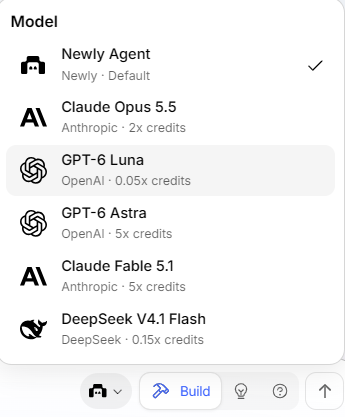
Our account offered several selectable models with different credit multipliers. The default is Newly Agent; alternatives shown included options at 0.05x, 0.15x, 2x and 5x. Credit consumption can therefore depend materially on model choice. Our benchmark used the default Newly Agent throughout, and we have not estimated costs for other models.
Newly currently has no free plan. Its main pricing page at newly.app/pricing and official FAQ advertise an entry plan at $25/month with 100 credits/month, verified October 28, 2026. The partner also confirmed this standard allowance in writing. Our October 25 complimentary test account showed a $25 plan with 100 credits; that historical observation is separate from the current published pricing and later partner confirmation. The 100-credit allowance is no longer merely an unknown test-account figure.
Some secondary official pages, including newly.app/create and newly.app/mobile-app-builder, still show 50 credits for $25/month. The public documentation is therefore not fully consistent. Newly's FAQ describes per-interaction credit pricing, while its Terms describe variable consumption based on the work the agent performs — reading the project, writing code, building, checking and automatic fixes. In our test, individual requests sometimes consumed multiple credits, including roughly 3 credits for the monthly/annual billing iteration. Newly is investigating that observation; it is not a confirmed bug. Check the applicable pricing and credit terms before buying rather than assuming a fixed one-credit-per-prompt cost.
Source export and lock-in
We downloaded the full project ZIP and inspected it ourselves. It was substantial: React Native / Expo app code, TypeScript and configuration, backend code, database schema and migrations, authentication logic, tests, deployment-related code and assets. The backend used broadly standard technology — Hono, Drizzle, Postgres/Neon-related infrastructure, Cloudflare Workers and Better Auth.
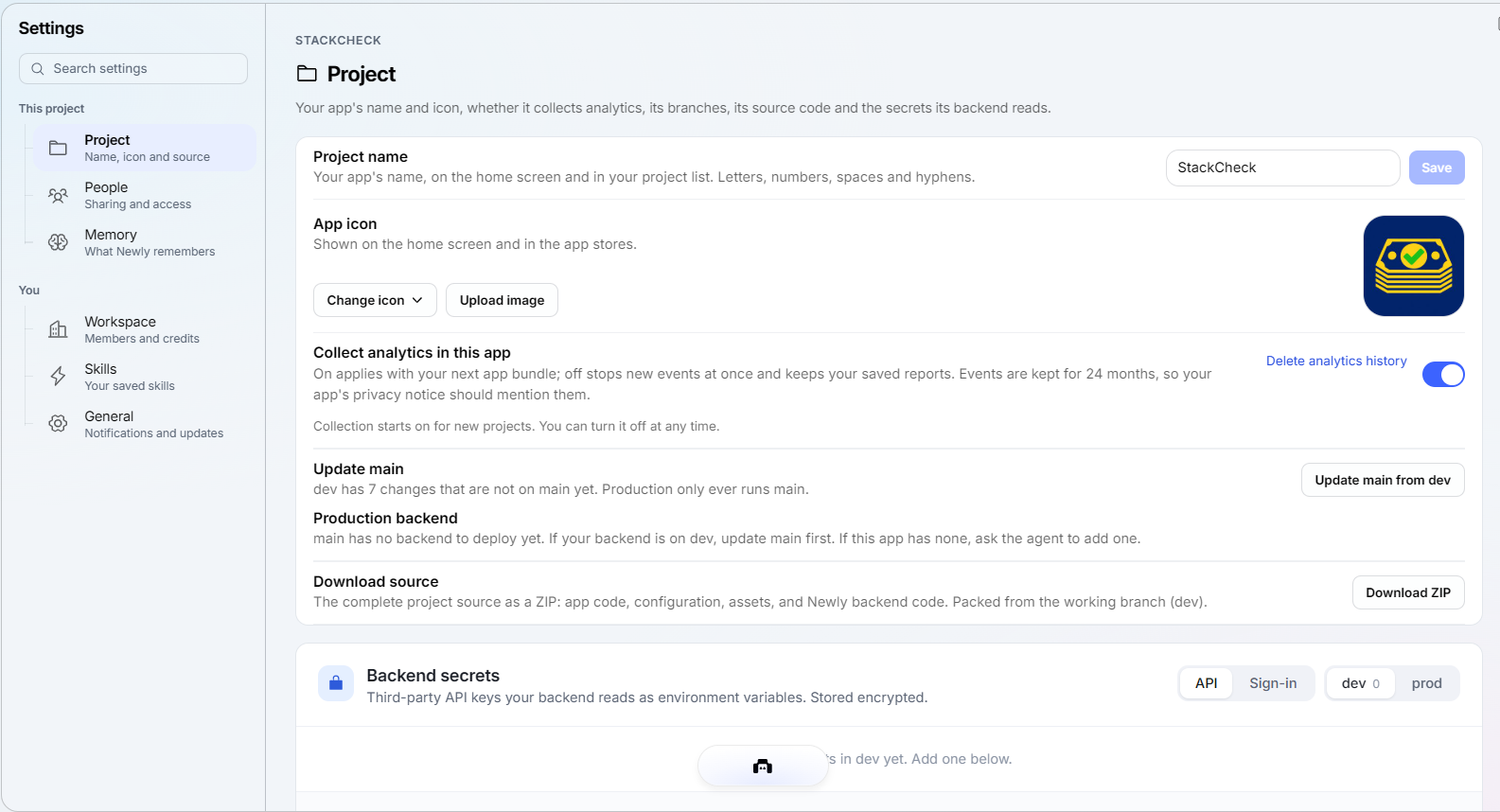
The export still contained Newly-specific dependencies and infrastructure references, including @newly/sdk-react-native, Newly analytics, Newly-hosted API/auth endpoints, Newly build-provenance tooling and platform-injected backend configuration. Analytics were also enabled by default in the tested project's settings.
Source-code exportability
High
Operational portability
Medium
Leaving Newly appears feasible without rewriting the application, but it would require a real infrastructure migration rather than deploying the ZIP unchanged.
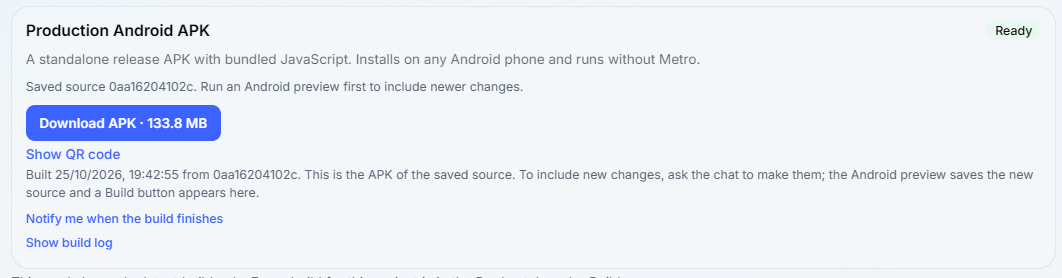
Android APK
Newly generated a standalone production Android APK: status Ready, 133.8 MB, downloadable directly from Newly, with bundled JavaScript. We downloaded and statically inspected it. APK successfully generated and downloaded; physical-device installation was not tested.
What we tested vs what we did not verify
Tested hands-on
- First-generation app on the iOS simulator: dashboard, detail view, add, edit, delete with confirmation, dashboard recalculation
- Monthly / annual billing iteration ($120/year normalized to $10/month)
- Renewal/trial date, reminder toggle, permission behavior and displayed reminder dates
- Sign-up, logout/login, session persistence across restart, local-to-cloud import, cloud CRUD
- Two-account isolation at the UI and API level; unauthenticated requests rejected
- Source ZIP download and independent inspection
- Android APK generation and download, plus static inspection of the APK
Not verified
- That the operating system actually fired the scheduled reminder notification
- Android on a physical device or emulator (the build succeeded; the app was not run)
- Installing the APK on a phone
- Deploying the exported ZIP outside Newly
- App Store / Google Play submission
- Long-term credit use beyond our session, and non-default models
Where the agent implemented something we did not check ourselves, we say so. Newly's own marketing describes its output as production-ready with full source ownership; we did not test those claims as such, and our findings are limited to this session.
Pros, cons and who it fits
Strengths
- Working React Native / Expo app from the first prompt
- Iterative changes preserved existing records and features
- Generated backend with auth, cloud persistence and per-user isolation
- Agent found and fixed a real backend auth bug on its own
- Substantial source export: app, backend, schema, migrations, tests
- Standalone Android APK generated in-platform
Watch-outs
- Embedded iOS simulator repeatedly hit a 20-minute install timeout
- Small UX/state bugs appeared during iteration
- Added features we did not ask for — adherence good, not perfect
- Credit use depends heavily on the selected model
- Export still references Newly-hosted endpoints and tooling
- No device-level verification of Android or notifications in our test
Likely fit: founders and non-specialist builders who specifically want a native mobile app rather than mainly a web app; people who value source-code access; and MVP or prototype work where iterative AI development is acceptable.
More caution: teams that need predictable simulator and testing infrastructure; teams expecting an immediately infrastructure-independent export; and production-critical apps that need rigorous device QA without developer review.
For the structured pre-purchase view, see the Newly Decision Passport or compare options in the best AI app builders for non-technical founders.
Frequently asked questions
What did Toolessence build with Newly?
A native mobile app called StackCheck for tracking software subscriptions and buying decisions: a dashboard, saved tools with full create/edit/delete, search and filtering, monthly spend calculations and local storage, later extended with annual billing, renewal reminders, authentication and cloud data.
Does Newly generate real native code?
Yes, in our test. Newly generated a React Native / Expo project, and the downloaded source ZIP contained the app code, TypeScript configuration, backend code, database schema and migrations, authentication logic, tests and assets.
Was the embedded iOS simulator reliable?
Not consistently. It genuinely worked and we used StackCheck interactively, but several launches failed because the remote simulator installation exceeded Newly's 20-minute control-plane deadline, including a run of consecutive failures. The iOS and Android builds themselves succeeded, so we treat this as platform infrastructure friction, not a crash in the generated app.
Did the reminder notifications work?
We verified the date workflow, reminder toggle, permission behavior and the reminder dates shown in the app. We did not independently confirm that the operating system fired the scheduled notification. We also saw a date picker that let taps reach controls behind it and helper text that did not always restore after changing dates.
Can you leave Newly without rewriting the app?
It appears feasible. Source-code exportability was high. Operational portability was medium: the export still referenced Newly-specific pieces such as @newly/sdk-react-native, Newly analytics, Newly-hosted API/auth endpoints, build-provenance tooling and platform-injected backend configuration, so leaving would require an infrastructure migration rather than deploying the ZIP unchanged.
Did you test the Android app?
Newly generated a standalone Android APK (status Ready, 133.8 MB) that we downloaded and statically inspected. We did not install it on a physical Android device or run it in an emulator.
How much did the test cost in credits?
The monthly/annual billing change consumed roughly 3 credits in our account using the default Newly Agent. Newly is investigating this observation; we do not label it a confirmed bug. The FAQ describes per-interaction credit pricing, while the Terms describe variable credit consumption based on the work the agent performs. Individual requests sometimes consumed multiple credits in our test. Newly also offers models with different credit multipliers; we did not benchmark those models.
What is Newly's advertised entry plan?
Newly currently has no free plan. Its main pricing page and FAQ advertise $25/month with 100 credits/month, verified October 28, 2026, and the partner confirmed this standard allowance in writing. Our October 25 complimentary test account also showed $25 with 100 credits, but the current allowance is no longer merely an unknown test-account figure. Secondary official pages, including /create and /mobile-app-builder, still show 50 credits for $25/month, and the FAQ's per-interaction description differs from the Terms' work-based credit model. Check the applicable pricing and credit terms before buying.
Was this review sponsored?
No. Newly provided complimentary access (our October 25, 2026 test account showed a $25 plan with 100 credits, ending October 30, 2026). That access did not determine the verdict, and Newly had no editorial control over this review. Separately, the advertised $25/month entry plan with 100 credits/month was verified on the main pricing page and FAQ on October 28, 2026 and confirmed by the partner in writing.