
SE Ranking review · 2026
SE Ranking Review 2026: SEO Toolkit with AI Search Visibility Tracking
SE Ranking combines classic SEO tools — rank tracking, keyword research, website audit, competitor research, backlinks, and reporting — with AI Search visibility features for tracking how brands appear across AI-generated answers.
If you are publishing content, tracking rankings manually, preparing SEO reports for clients, or trying to understand why competitors are gaining visibility, the problem is rarely just "needing more SEO data." The real problem is turning scattered keyword movements, audits, backlinks, competitor signals, and AI visibility data into a clear action plan.
Toolessence may earn a commission if you buy through our links, at no extra cost to you.
Best starting point for agencies, consultants, founders, and content teams that need clearer SEO visibility across rankings, audits, competitors, reports, and emerging AI search results.
Quick verdict
SE Ranking is best for SEO teams, agencies, founders, and marketers who want a broad SEO platform without jumping immediately to enterprise-level tools. Its strongest angle in 2026 is the combination of traditional SEO workflows with AI Search visibility tracking.
- Best for: SEO teams, agencies, content sites, founders, and marketers.
- Strongest areas: Website audit, keyword research, rank tracking, competitor research, AI Search visibility, reporting.
- Watch out for: Some reports need tracked keywords, competitors, prompts, historical data, or connected integrations before they become fully useful.
Simple decision: SE Ranking is worth evaluating if you need a practical all-in-one SEO workspace for rank tracking, audits, competitor research, reporting, and AI Search visibility. If you only need occasional keyword checks or very deep enterprise SEO data, a simpler or more specialized tool may be a better fit.
What is SE Ranking?
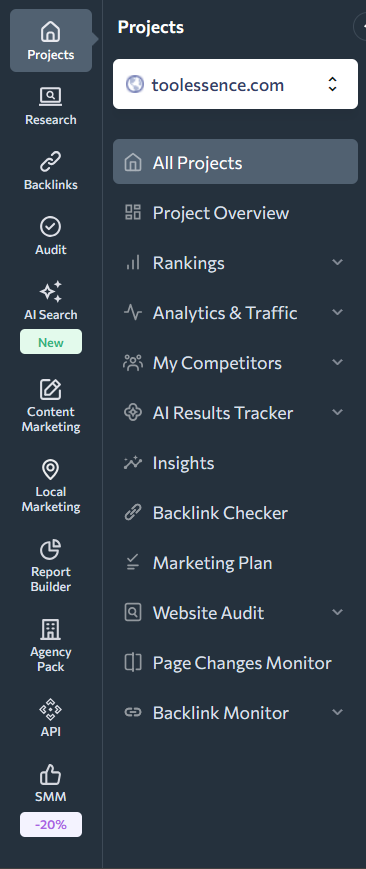
SE Ranking is an all-in-one SEO platform covering rank tracking, website audit, keyword research, competitor research, backlinks, content marketing, local marketing, reporting, and agency workflows. It is positioned for SEO teams and agencies that want broad coverage in one environment rather than stitching together several point tools.
What we reviewed
We reviewed SE Ranking's interface, project structure, available modules, and official AI Search documentation to understand where the platform fits best. We used Toolessence as a project inside SE Ranking, but since Toolessence is a new website, some datasets are naturally limited at this stage.
For the AI Search side, we relied on SE Ranking's official documentation covering AI Search, AI Results Tracker, AI Search in Competitive Research, Sources, Competitors, Rankings, Insights, and the AI Search Add-on.
Because project-based SEO tools depend on tracked keywords, competitors, historical data, prompts, and connected integrations, new websites may show limited data at first. This review focuses on workflow structure, available modules, AI Search capabilities, and practical fit — not a long-term historical performance case study.
Where SE Ranking becomes useful
SE Ranking tends to pay off in concrete buyer moments — situations where scattered SEO data needs to become an action plan:
- You need to show a client what changed in rankings and visibility this month.
- You are trying to understand which pages or keywords are gaining or losing traction.
- You want technical audit issues, keyword research, competitors, backlinks, and reports in one workspace instead of five disconnected tools.
- You want to monitor not only Google rankings but also how your brand appears in AI-generated answers across major AI platforms.
- You need enough SEO structure to act, without assembling a messy stack of separate tools.
Website Audit
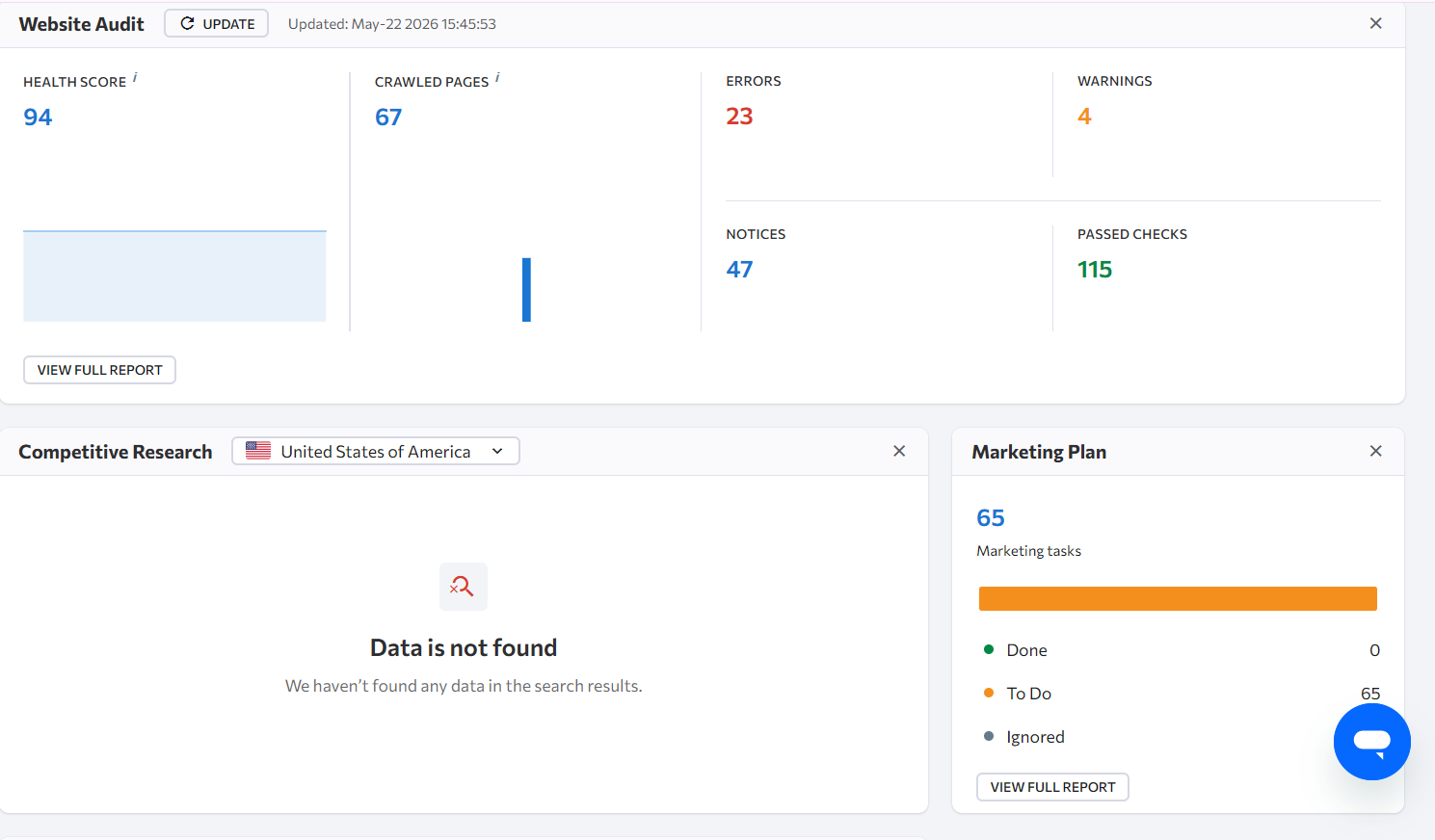
Website Audit is one of the clearest modules in SE Ranking because it turns technical SEO into structured diagnostics — a health score plus errors, warnings, notices, and passed checks across crawled pages. It is useful for identifying technical issues and pages that need further review, without forcing you to interpret raw crawl logs.
Keyword Research
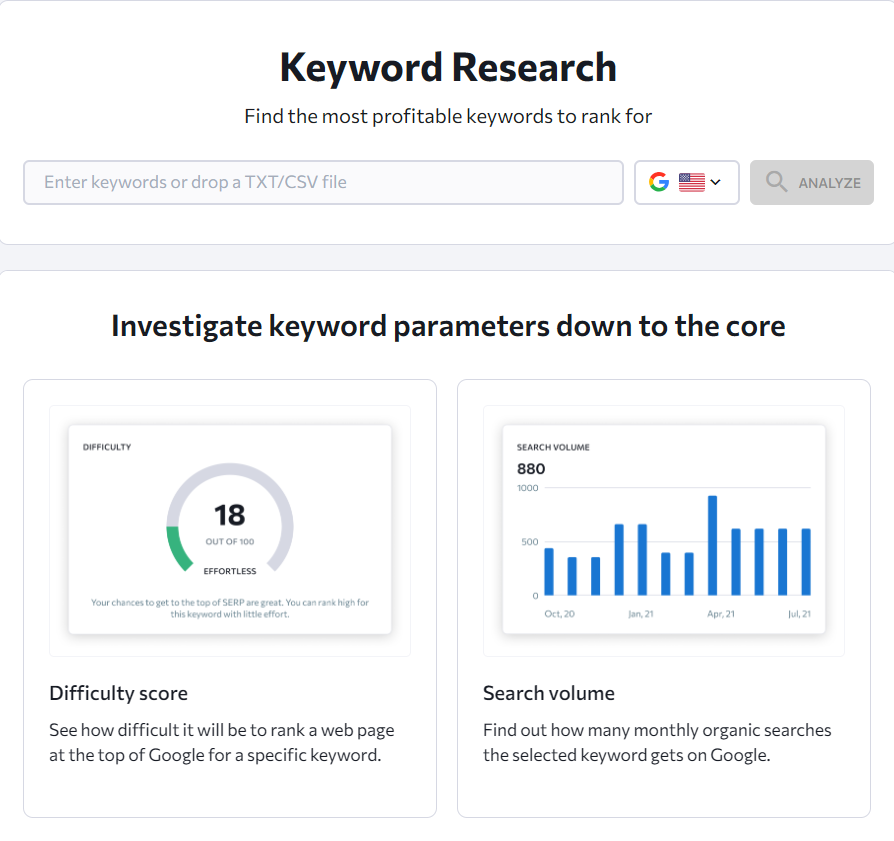
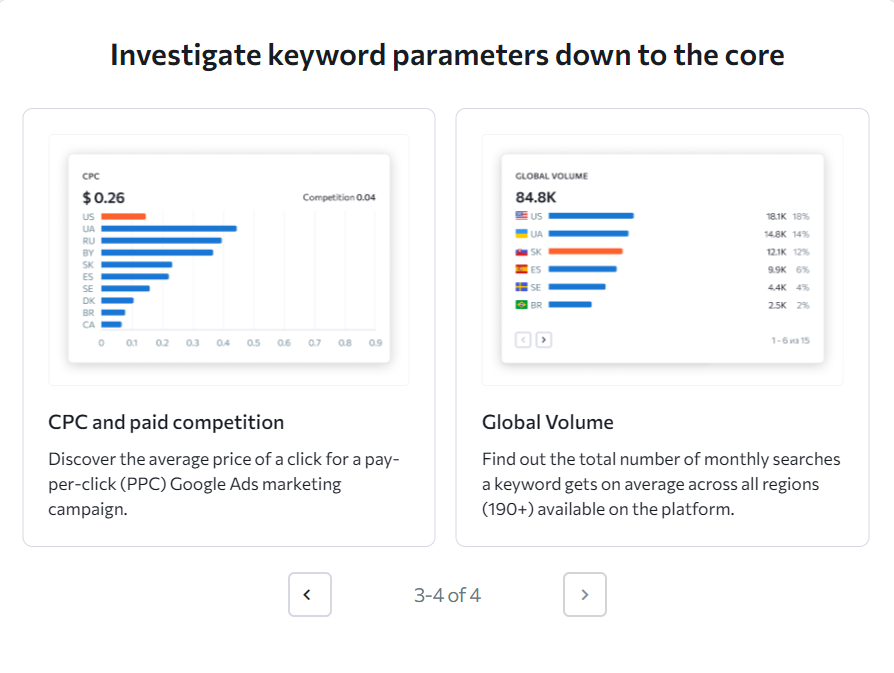
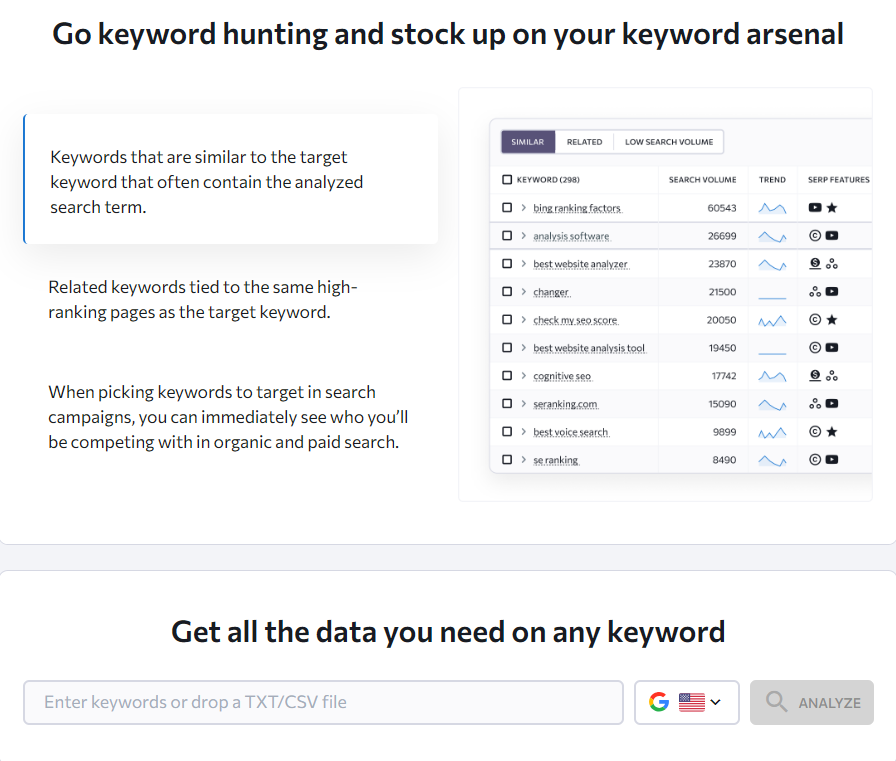
SE Ranking's keyword workflow covers difficulty, search volume, CPC, paid competition, global volume, similar and related keywords, bulk keyword analysis, Keyword Manager, and historical data. The interface is structured around evaluating a keyword from multiple angles in one view.
If you are comparing approaches, our Surfer SEO alternatives guide covers adjacent workflows for on-page and content-driven SEO.
Competitor Research and Share of Voice
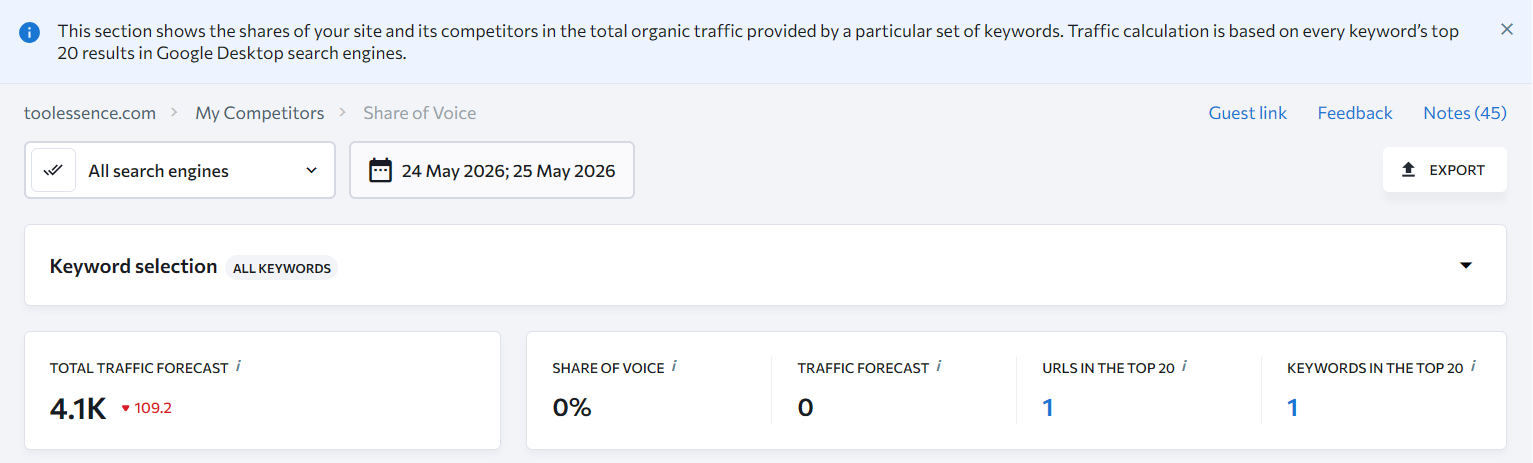
Competitor research becomes more useful when you have a defined keyword set and a real list of competitors. For new websites, this area may start with limited data and become more valuable as rankings and tracking history accumulate inside the project.
Insights and recommendations
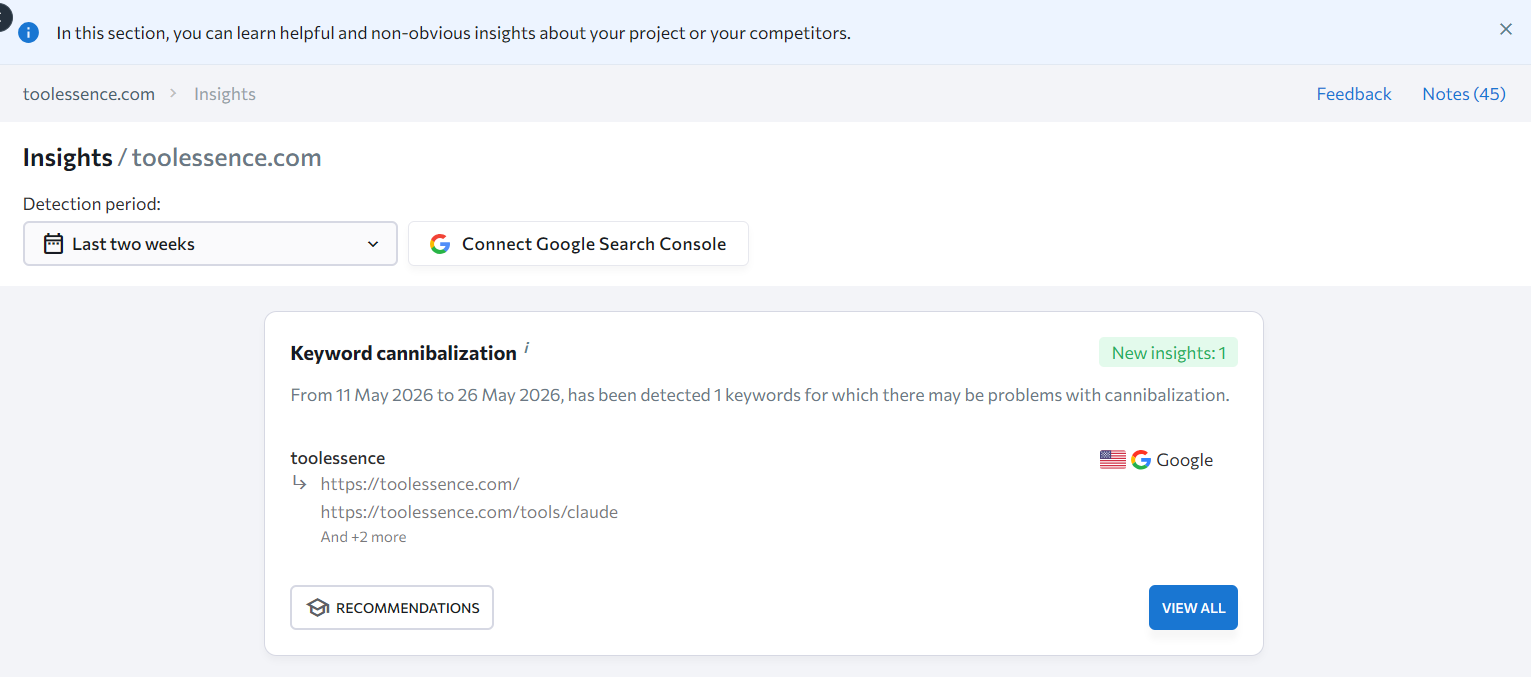
The Insights area helps move from raw data to actionable recommendations — for example identifying keyword cannibalization, optimization opportunities, or project-level issues worth investigating.
AI Search: SE Ranking's most interesting 2026 angle
SE Ranking's AI Search features are designed to help users understand how their website, brand, competitors, and sources appear in AI-generated answers. According to SE Ranking's documentation, this spans two areas: AI Results Tracker inside projects and AI Search inside Competitive Research.
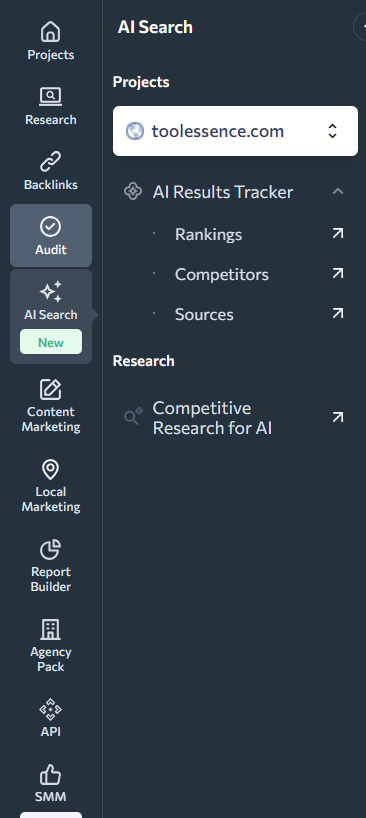
AI Results Tracker
- Brings AI visibility metrics together in one place.
- Shows how your website and brand appear in Google AI Overviews, Google AI Mode, Gemini, ChatGPT, and Perplexity.
- Helps measure brand mentions or links in AI-generated results.
- Helps track your standing next to competitors.
- Helps discover pages and domains influencing AI answers.
Important nuance: AI Results Tracker is based on configured projects, AI platforms, prompts, and competitors. It should not be described as monitoring every random user prompt on the internet.
AI Search in Competitive Research
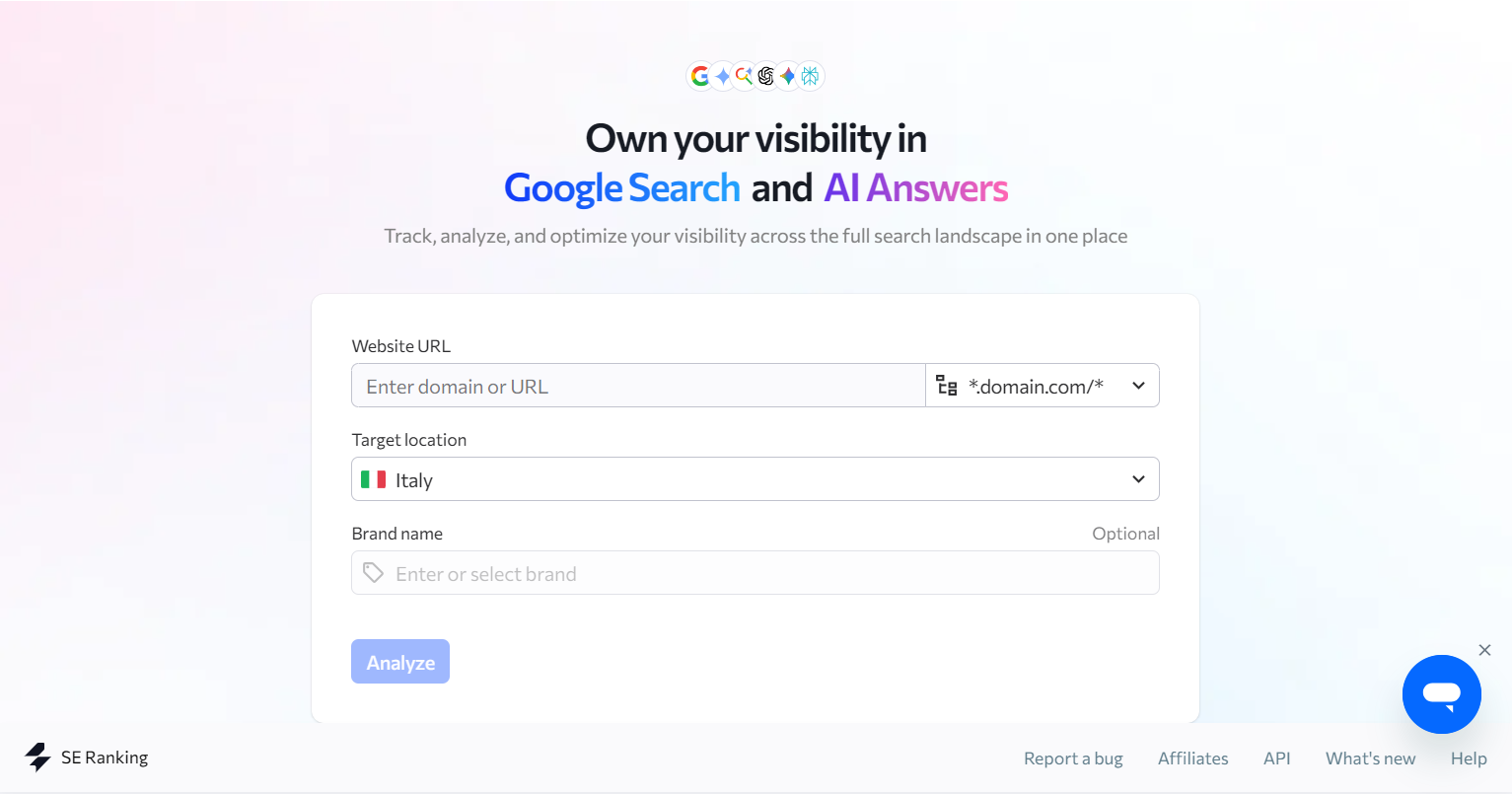
- Analyzes how a brand or domain appears in AI-generated answers.
- Supports Google AI Overview, Google AI Mode, ChatGPT, Gemini, and Perplexity.
- Can measure AI Presence, Brand Presence, and Domain Presence depending on setup.
- Can help benchmark against competitors and identify gaps.
If you enter only a domain, only Domain Presence may be available. Adding a brand name enables broader brand and overall AI presence analysis.
AI Results Tracker: Rankings, Competitors, and Sources
Rankings
Tracks how often a brand or website is mentioned in AI-generated results, including metrics SE Ranking describes such as Top 3 Presence, Source Presence, mention and link presence trends, and Organic–AI Overlap for AI Overviews.
Competitors
Shows which brands or domains appear next to yours in AI-generated answers for tracked prompts. Useful for understanding AI visibility competitors, which can differ from your traditional SERP competitors.
Sources
Shows which pages and domains AI platforms rely on when generating answers. Useful for identifying citation sources, outreach opportunities, competitor-only mentions, and mentions without backlinks.
AI Search Add-on and SE Visible
SE Ranking's AI Search Add-on extends AI functionality inside the SE Ranking account. It provides expanded limits and advanced capabilities for teams managing multiple brands or larger datasets.
The Add-on includes extended limits for AI Results Tracker, expanded AI Research in Competitive Research, and access to SE Visible.
SE Visible is described in SE Ranking's documentation as a standalone product for strategic AI visibility insights that can work alongside the AI Search Add-on. We have not personally tested it long-term, so this overview reflects how SE Ranking positions the product rather than a hands-on evaluation.
Agency, reporting, and broader modules
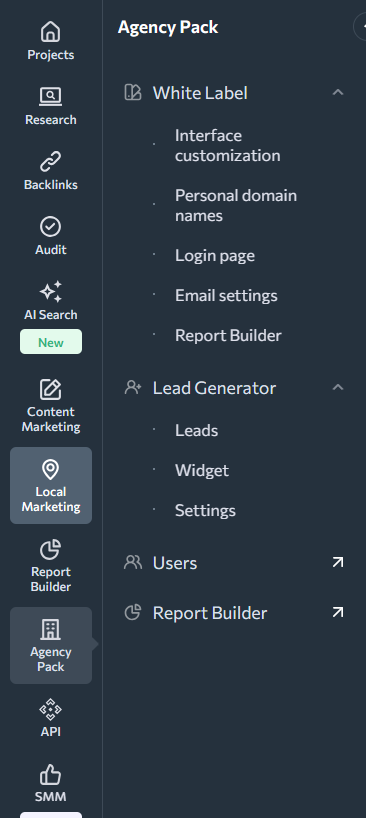
SE Ranking also includes content marketing, local marketing, backlinks, audit, reporting, and dedicated agency features. These matter most for teams managing multiple projects or clients, where white label, lead generation, user management, and structured reporting reduce manual overhead.
Pros
- Broad SEO platform, not just a rank tracker
- Strong Website Audit workflow
- Keyword research covers difficulty, volume, CPC, competition, and related terms
- Competitor and share-of-voice features for tracked projects
- AI Search visibility features are timely and strategically relevant
- Agency and reporting modules make it useful for consultants and teams
- Good fit for users who want SEO and emerging AI visibility in one environment
Cons
- •Can feel broad or dense for beginners
- •Some reports depend on setup, tracked keywords, competitors, prompts, and historical data
- •New websites may show limited data at first
- •Advanced AI Search workflows may require add-on limits or careful configuration
- •Users who only need one simple keyword checker may find it more than necessary
Who SE Ranking is best for
- SEO teams that want an all-in-one platform
- Agencies managing multiple clients or reports
- Affiliate and content sites building organic traffic
- Founders and operators who want structured SEO workflows
- Marketers who want classic SEO tracking plus AI Search visibility monitoring
- Teams that want to monitor competitors across search and AI-generated answers
Who SE Ranking may not be ideal for
- •Users who only need a free one-off keyword checker
- •Beginners who do not want to configure projects, keywords, or competitors
- •Brand-new sites expecting rich historical data immediately
- •Users who only need AI writing, not SEO research and tracking
- •Users who expect AI tracking to monitor every possible random prompt without defining prompts or queries
Final verdict
SE Ranking is easiest to justify when you will actually use several parts of the platform together: rank tracking, audits, keyword research, competitor monitoring, backlinks, reporting, and AI Search visibility. If those workflows matter to your business or your clients, it is a serious tool to evaluate — not just another rank tracker.
Its value is clearest when you actively track projects, keywords, competitors, and prompts over time, so the data layered across modules becomes a real action plan instead of isolated screenshots.
For brand-new sites, some reports will naturally start thin — this is normal data maturity, not a confidence problem — and the platform becomes more useful as data accumulates. The AI Search features make SE Ranking especially interesting for SEO teams and brands that want to understand not only where they rank on Google, but also how they appear in AI-generated answers. For broader context, see our best AI SEO tools for 2026 and the SE Ranking tool page.
If you want to compare SE Ranking with similar platforms, see our SE Ranking alternatives.
Try SE RankingFrequently asked questions
Is SE Ranking worth it for small businesses?+
For most small businesses that publish content, want to track keywords, run a technical audit, and watch a few competitors, SE Ranking covers the core workflow in one place. It is usually easier to justify than enterprise SEO suites, and you can start with the modules you actually need.
Is SE Ranking good for agencies?+
Yes. The Agency Pack adds white label, lead generator, user management, and a report builder, which makes it a practical fit for agencies and consultants managing multiple clients and recurring SEO reporting.
Can SE Ranking replace Semrush or Ahrefs?+
For many SEO workflows — rank tracking, audits, keyword research, competitor research, backlinks, reporting, and AI Search visibility — SE Ranking is a credible alternative and often more accessible on price. Whether it fully replaces Semrush or Ahrefs depends on how deeply you rely on enterprise-grade datasets and large backlink indexes.
Is SE Ranking good for rank tracking?+
Rank tracking is one of SE Ranking's core strengths. You can track keywords across locations and devices, monitor visibility over time, and combine rankings with competitor and share-of-voice data inside the same project.
Does SE Ranking include client reporting?+
Yes. SE Ranking includes a report builder and agency-oriented features such as white label and user management, so client reporting can be standardized across multiple projects without exporting data to other tools.
Is SE Ranking useful for AI Search visibility?+
Yes. SE Ranking's AI Results Tracker and AI Search inside Competitive Research are designed to show how your website and brand appear in AI-generated answers across platforms such as Google AI Overviews, Google AI Mode, ChatGPT, Gemini, and Perplexity. Coverage depends on configured projects, prompts, and competitors.
Who should not use SE Ranking?+
Users who only need a quick one-off keyword check, who do not want to configure a project with keywords and competitors, or who only need AI writing rather than SEO research and tracking will likely find SE Ranking more than they need.
Is SE Ranking good for beginners?+
It is approachable but not minimal. Beginners can use modules like Website Audit and Keyword Research without much setup, but the platform is broad — getting full value typically means configuring a project with tracked keywords, competitors, and ideally AI Search prompts.
Does SE Ranking track AI Overviews?+
According to SE Ranking's documentation, the AI Results Tracker covers Google AI Overviews and Google AI Mode alongside other AI platforms. Coverage depends on configured projects, prompts, and the AI platforms you choose to track.
What is the AI Search Add-on?+
An add-on that extends AI functionality inside SE Ranking — expanded limits for AI Results Tracker, broader AI Research in Competitive Research, and access to SE Visible, a related product for strategic AI visibility insights.
Is SE Ranking useful for new websites?+
Yes, but expect normal data maturity. Modules like Website Audit and Keyword Research are useful immediately. Competitor share-of-voice, rank tracking, and AI Search insights become more useful as you accumulate tracked keywords, prompts, competitors, and historical data.